As digital channels become more crowded, direct mail automation is emerging as a critical part of the marketing mix. Mailers continue to outperform expectations and remain a preferred strategy for leading companies like Google.
But don’t take our word for it — the research below speaks for itself.
You might be surprised to see just how big a difference direct mail can make in your marketing results…
Check it out:
People are increasingly fatigued by digital ads and content, letting direct mail shine.
Digital advertising has exploded over the past couple of decades. Recent research shows that Americans now spend 10 hours online every day. Post-pandemic, some reports estimate adult screen time climbed 60–80%. It’s no surprise that all this scrolling is taking a toll: in one survey, 46% of people said excessive screen time was a major reason they felt constantly drained. So what does that mean for your marketing results? Here are a few insights…
- 81% of respondents unsubscribe from brands that send messages excessively. Optimove (2024)
- 54% of respondents have unsubscribed from at least 3 brands in the past 90 days. Optimove (2024)
- Email (35%) and text (26%) are the most irritating channels when consumers feel bombarded with excessive messages. Mobile push notifications and mobile web ads tied for third most irritating (14%) and social media ads were deemed less irritating (9%). Optimove (2024)
- Digital trust issues: 39% of consumers are unlikely to trust a brand that only engages with them digitally (e.g., email, text, and social). CompereMedia (2024)
- Direct mail is a safer channel to employ personalization: 59% of respondents are more concerned about seeing their personal information in a digital ad than in a direct mail ad, and 64% have privacy concerns with personalized and targeted digital advertisements. CompereMedia (2024)
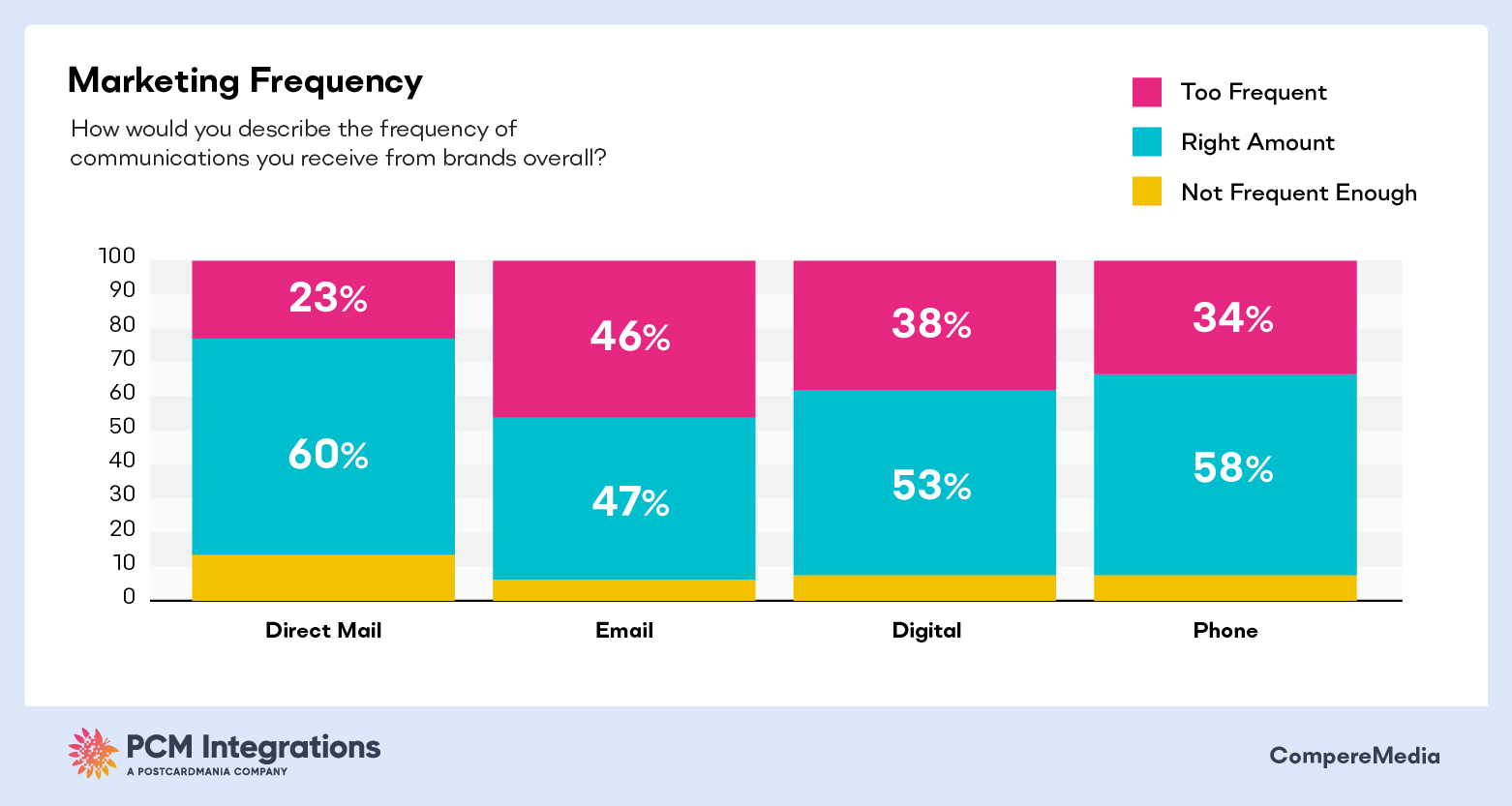
- Only 23% of respondents reported that they receive direct mail pieces too frequently, far fewer than all other channels, including email (46%), digital ads (38%), and phone calls (34%). Additionally, 16% of respondents report that they don’t receive enough direct mail. CompereMedia (2024)
- People spend 45% longer engaging with direct mail ads than digital ads (1.6 minutes for mail compared to 1.1 minutes for digital). Vericast (2024)
- 55% of people say they pay more attention to direct mail ads compared with 39% for digital ads. Vericast (2024)
- 60% say direct mail is easy to remember when ready to make a purchase, compared with 44% for digital ads — a difference of 36%. Vericast (2024)
- Most consumers reported being overwhelmed by digital brand communications, including email (69%) and social media (61%). RRD (2023)
- One in five consumers (20%) reports having deleted a social media account in the last year. RRD (2023)
- Nearly half (46%) of all consumers surveyed are more cautious about sharing personal data online. RRD (2023)
- 93% of marketers report that digital privacy concerns have influenced their digital marketing strategy, with 75% reallocating some of their marketing budget into direct mail. RRD (2023)
- Digital fatigue is felt on both sides of the consumer journey — 88% of marketers say their customers have become overwhelmed by the increased use of digital marketing channels, and 75% of consumers agreed with the statement: “I’m overwhelmed by the number of digital ads and/or marketing emails I see daily.” SG360 (2022)
- Digital fatigue is felt across all generations — 75% of Gen Z, 76% of Millennials, 73% of Gen X, 76% of Baby Boomers, and 71% of the Silent Generation agree they are overwhelmed by digital ads and email. SG360 (2022)
- 86% of web users experience banner blindness. Infolinks (2013)
Direct mail has a higher response rate than other forms of advertising.
According to USPS data, the typical household gets dramatically more emails than physical mail each day — roughly two pieces of direct mail compared to about 157 emails, a staggering 7,750% difference. With the nonstop flood of online ads, people are growing increasingly fatigued and tuning them out. As a result, consumers are now more open to engaging with direct mail marketing than they’ve been in years.
- 97% of direct mail users see higher response rates with personalized/customized direct mail, and 56% said that response rates were significantly higher with personalized/customized direct mail. Keypoint Intelligence (2024)
- 85% of marketers agree that direct mail delivers the best conversion rate of all channels they use, up from 74% in 2023. CompereMedia (2024)
- 84% of marketers agree that direct mail delivers the best response rate of all channels they use, up from 74% in 2023. CompereMedia (2024)
- 88% say they see conversion rates from direct mail at least 5% higher than their next closest marketing channel. SG360 (2024)
- 69% of marketers saw response rates of more than 3% from direct mail, while 33% saw response rates of 5% or better, and 11% saw response rates of 7% or better. SG360 (2023)
- 36% of people have a specific place in the house where they save print ads of interest. Vericast (2024)
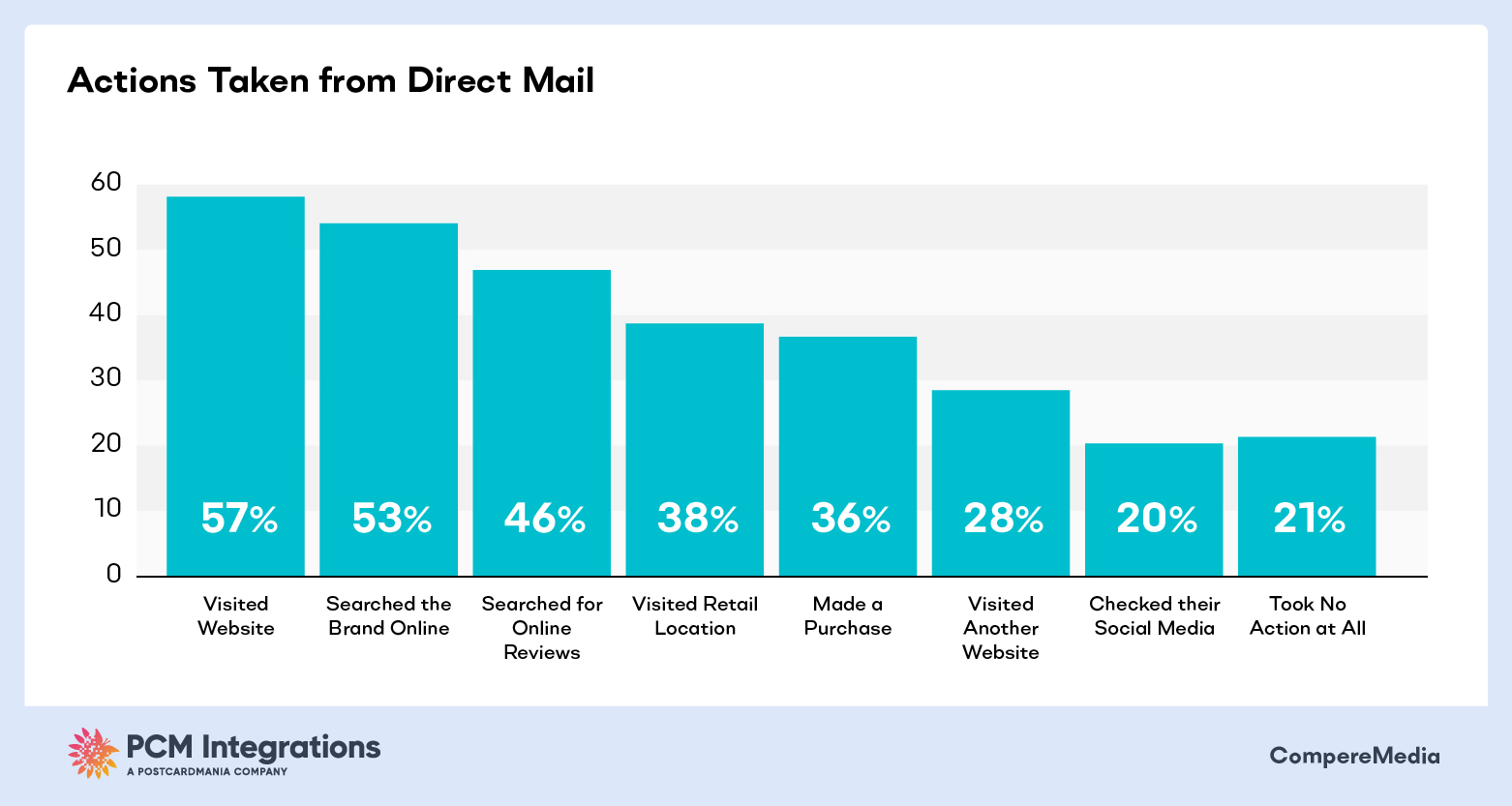
- Actions consumers have taken as a result of receiving direct mail: 57% visited the brand’s website, 53% searched for that brand online, 46% searched for online reviews, 38% visited a retail location, 36% made a purchase, 28% visited another website, 20% checked that brand’s social media. The State of Direct Mail (2023)
- 80% of consumers who scanned a direct mail Flowcode (aka QR codes that can be edited even after being printed) in one retail campaign volunteered their email addresses. The Direct Marketing Revolution Report (2023)
- 70% of marketers say their direct mail performance has improved in the last 12 months, an increase of 5% over 2022. Only 2% say performance declined, with the rest saying it stayed the same. Direct Mail Industry Report 2023 (2023)
- The average piece of business mail is interacted with for 150 seconds on average across a 28-day period; direct mail for 108 seconds; partially addressed mail for 64 seconds, and door drops for 46 seconds. Interestingly, people consistently self-reported spending more time with mail than was observed during research. JICMAIL Attention Study (2023)
- Direct mail that prompts a commercially beneficial outcome for a brand typically generates attention 2–3X times higher than average. JICMAIL Attention Study (2023)
- Direct mail evokes more time and attention on other channels. When prompted by direct mail, people on average spent: 5:33 online, 4:53 making a call, 1:36 using a smartphone, 0:33 writing an email, 0:29 talking about it, and 0:06 tearing off a voucher. JICMAIL Attention Study (2023)
- Some commercial actions don’t take long to take effect. It only takes 6 seconds to tear off a voucher from a mail item, but over a fifth of respondents had used vouchers in the last few weeks. JICMAIL Attention Study (2023)
- 81% of marketers who use a software platform for direct mail agree it delivers the best response rate their company uses today. This shifts to 70% for respondents who do not use a software platform. The State of Direct Mail (2023)
- 78% of B2B marketers agree their analog touchpoints (e.g., direct mail) have been performing better than they had a year ago. Forrester Opportunity Snapshot (2022)
- Marketers report better response rates — a lift of 18% — when direct mail is included in the multichannel mix. Demand Metric (2020)
- Direct mail has an average engagement rate of 95% and is interacted with at least 4 times at home. MarketReach (2021)
- Direct mail case studies grouped by WARC showed that 70% of people were driven toward an online activity by direct mail, and 35% of consumers made a purchase as a result of direct mail. MarketReach (2021)
- Direct mail is read more often than email among all age groups, and 71% of all consumers are excited to discover what the mail brings every day. USPS (2021)
- A record 96% of all mail was engaged with. This is an increase from 2019, which was at 91%. JICMAIL (2020)
- 75% of business mail stays in the home for over four weeks and is revisited an average of 5 times. MarketReach (2020)
- Direct mail response rates are 5 to 9 times higher than any other advertising channel. The Data & Marketing Association (2018)
- 39% of consumers try a business for the first time because of direct mail. The Data & Marketing Association (2018)
- In 2018, the average American household received 454 pieces of mail. The study revealed that 57% of consumers opened addressed mail envelopes, 48.5% looked at what it is, 24.5% kept it to read later, and 1.6% of the recipients put them in the open for display. USPS (2018)
- Direct mail’s average response rate increased from 2.9% to 4.9% for prospect lists and 5.1% to 9% for house lists (current customers/database) between 2017 and 2018. The Data & Marketing Association (2018)
- 90% of mail is opened by recipients, while only 20–30% of emails are opened/seen. DMA (2018)
- Postcards have the highest response rate (4.25%) among different types of direct mail, such as dimensional mailers (4%), catalogs (3.5%), and letter-sized envelopes (3.5%). DMA (2018)
- When compared to email, paid search, and social media, household mail has a higher response rate at 9%, with the former being only at 1%. The Data & Marketing Association (2018)
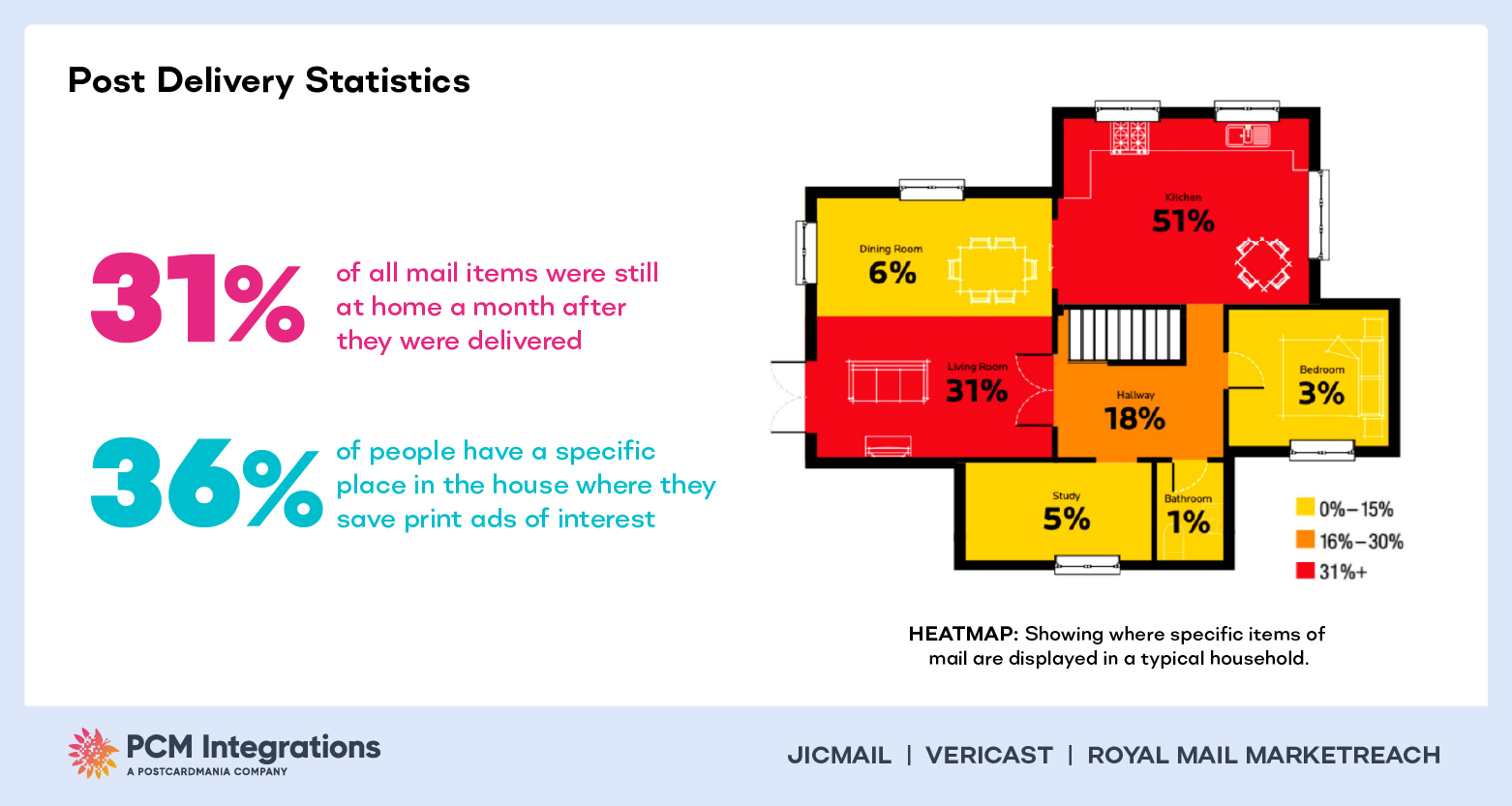
- A whopping 31% of all mail items were still at home a month after they were delivered. JICMAIL (2018)
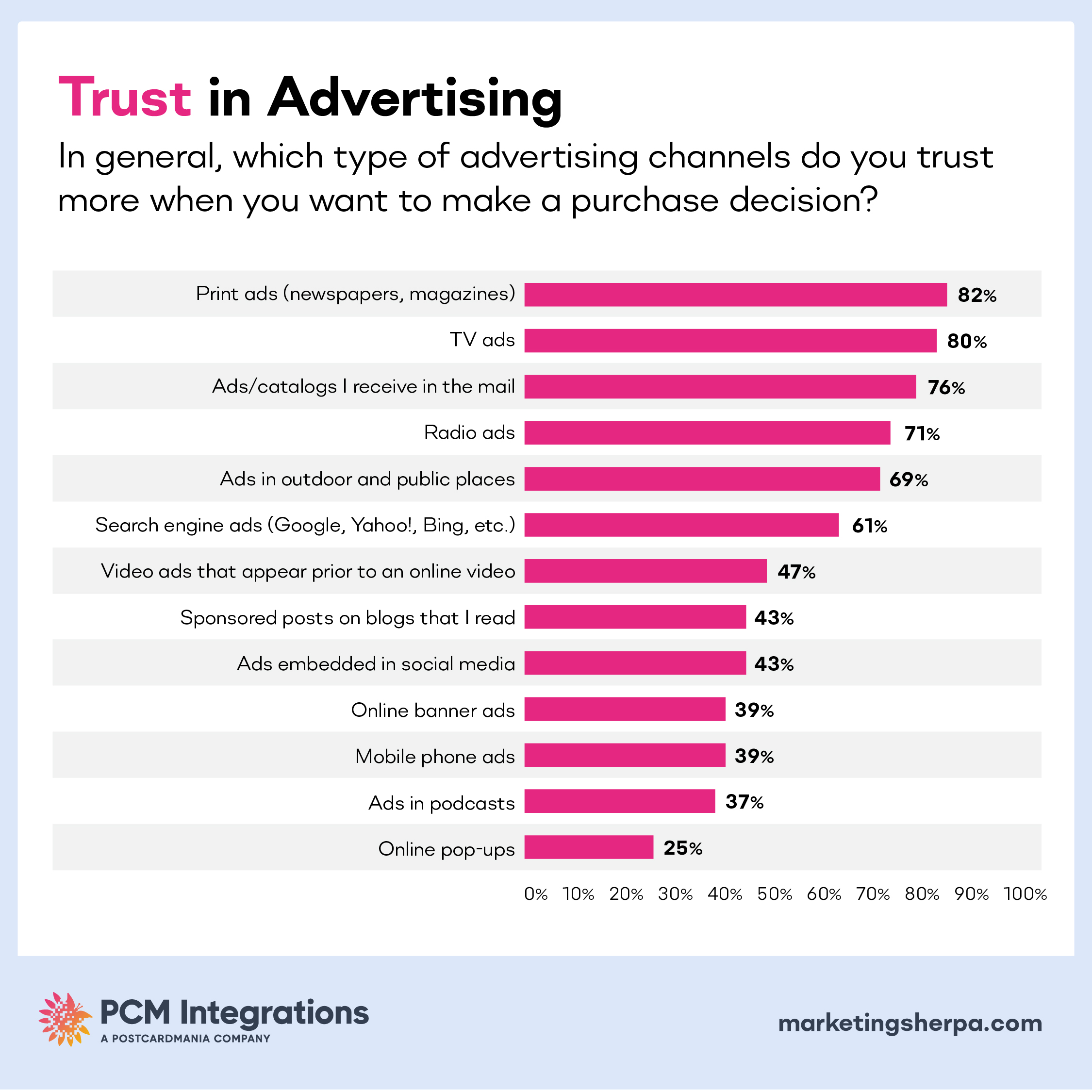
- One study asked 1,200 consumers which advertising channels they trusted more. 76% of the group said they trust direct mail (postcards, catalogs, etc.), which is just 6% less than the leading group that trusted ads in newspapers and magazines. Marketing Sherpa (2017)
- 42% of recipients read or scan the direct mail they receive. The Data & Marketing Association (2016)
- 56% of consumers who responded to direct mail went online or visited a physical store. InfoTrends (2015)
- 62% of consumers who responded to direct mail made a purchase. InfoTrends (2015)
- 66% of direct mail is opened, and 82% of direct mail is read for a minute or more. InfoTrends (2015)
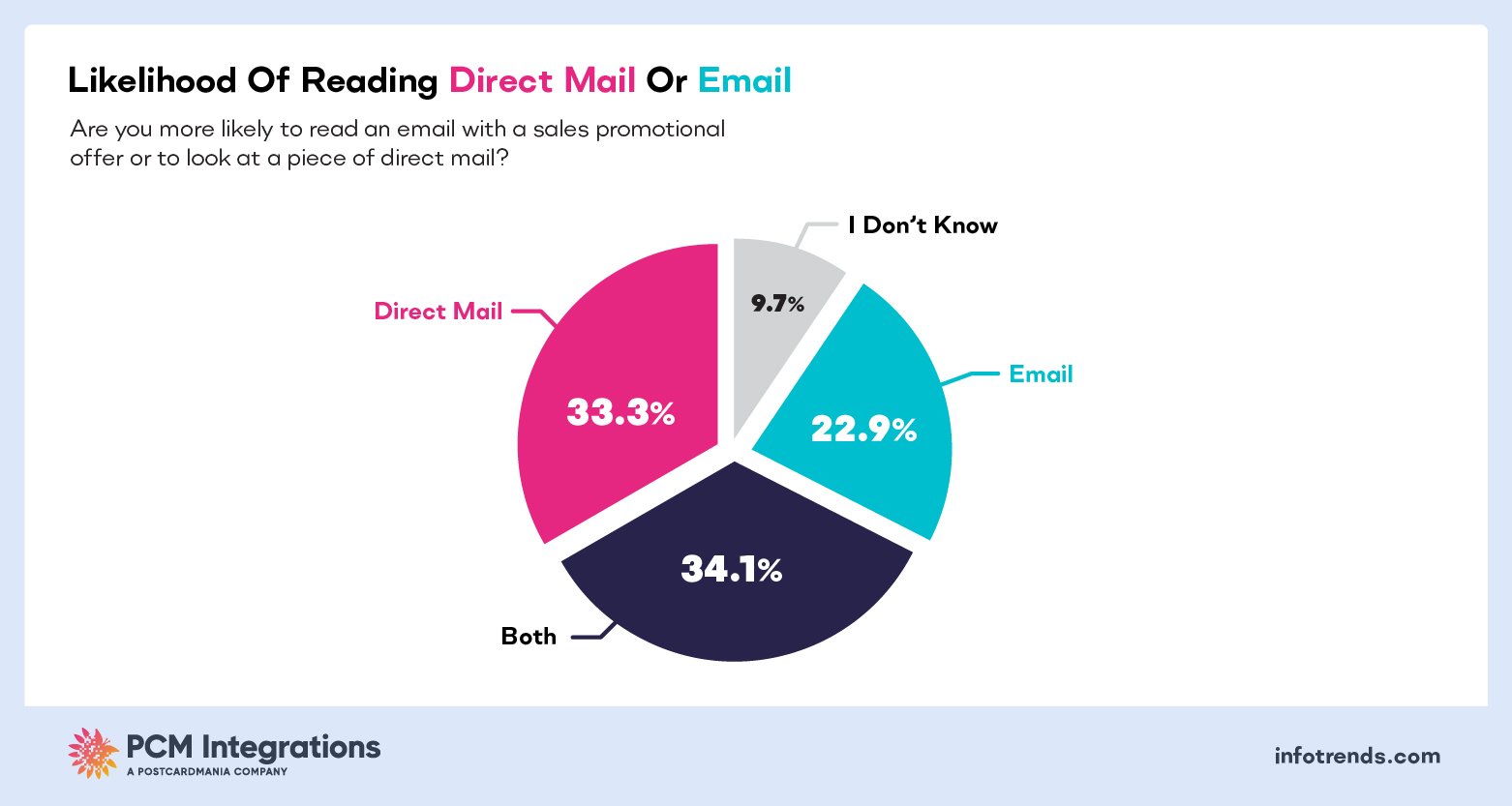
- 33.3% of people in one particular study said they were more likely to read direct mail than open and read emails, while 22.9% said they leaned toward reading emails. InfoTrends (2015)
- Mail boasts a stickiness in the home you won’t find with email or digital. Most mail (51%) is read and displayed in the kitchen, while nearly a third of mail (31%) can be found in the living room. This likely engenders repeat exposure and deeper brand recall. MarketReach (2014)
The majority of people view direct mail in a positive light, as opposed to other forms of marketing.
So what’s the real sentiment around direct mail? Turns out, most people actually enjoy receiving it. The numbers show that consumers generally respond positively to the ads that land in their mailboxes. This is why…
- Consumers rate mail as less overwhelming than: email marketing, sponsored social media content, paid online search/banner ads, TV/streaming ads, sponsored influencer content, and text messaging (in order from most overwhelming to least). Direct Mail Industry Report (2024)
- 72% regularly read or look at ads in the mail, with Gen X leading at 78%. Vericast (2024)
- 72% of consumers engage with mail each week, up 3% from last year. Direct Mail Industry Report (2024)
- 71% of consumers say physical marketing tactics are important for connecting with new and existing customers (Wix and VistaPrint, 2024)
- 70% of respondents read direct mail pieces on the same day they receive them, and 69% of respondents share direct mail pieces with friends and family. CompereMedia (2024)
- 60% say direct mail is easy to remember when ready to make a purchase, compared with 44% for digital ads. Vericast (2024)
- 54% of consumers appreciate mail because they can keep an interesting piece and refer to it later. Direct Mail Industry Report (2024)
- 50% of Americans say they prefer getting direct mail over email. IWCO (2024)
- Direct mail is the second most enjoyable form of advertising, second only to TV/video streaming. Direct Mail Industry Report (2024)
- 44% of consumers say mail feels less intrusive than other types of advertising. Direct Mail Industry Report (2024)
- 67% of people find mail trustworthy when it comes to privacy concerns. Vericast (2024)
- Two-thirds of respondents read direct mail pieces on the same day they receive them, and 69% say they often or sometimes share direct mail with friends and family. CompereMedia (2024)
- The likelihood of consumers visiting the URL included on a mail piece grew 3% in 2024 to 42%. Direct Mail Industry Report (2024)
- 54% consider taking time to read the mail a planned part of their daily routine; 57% for parents and 58% for Hispanic consumers. Vericast (2024)
- 54% find reading through mailed advertising enjoyable, rising to 66% among millennial parents. Vericast (2024)
- 52% of respondents say that receiving direct mail from a brand feels more important than receiving an email from a brand. CompereMedia (2024)
- 49% consider direct mail a part of their shopping routine (especially parents, 55%). Vericast (2024)
- 56% use it to plan their weekly grocery shopping, with parents leading at 62%. Vericast (2024)
- 51% start noticing and collecting direct mail when in the market to make a purchase or schedule a service, rising to 60% among parents. Vericast (2024)
- 54% say it’s relaxing, pleasurable to look through, especially parents (58%). Vericast (2024)
- People spend 45% longer engaging with direct mail ads (1.6 minutes) than their digital counterparts (1.1 minutes). Vericast (2024)
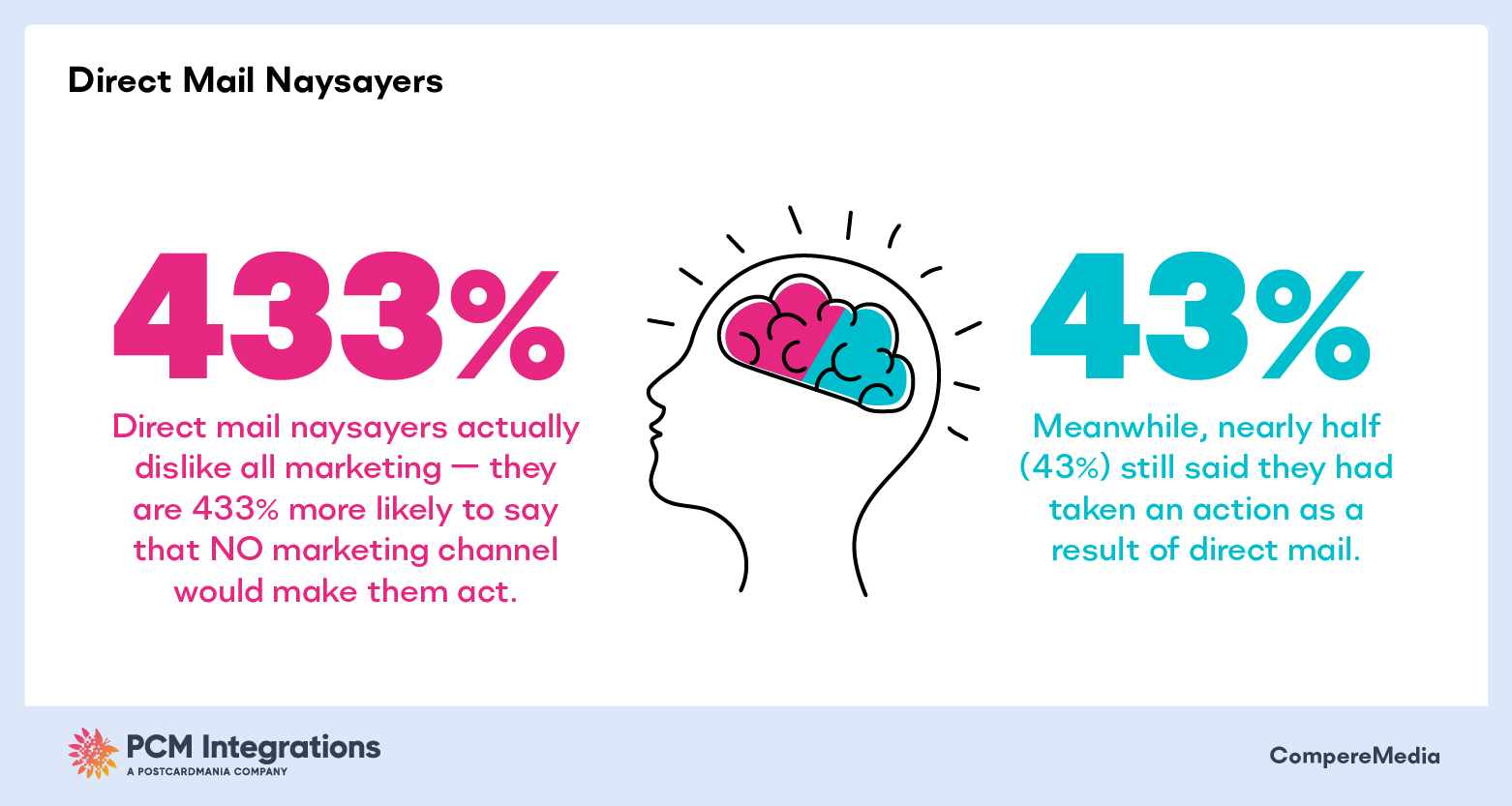
- Direct mail naysayers actually dislike all marketing — they are 433% more likely to say that NO marketing channel would make them act. At the same time, nearly half (43%) still said they had taken an action as a result of direct mail. SG360 (2023)
- 49% of Americans of all ages look forward to checking their mail each day. Vericast (2024)
- 54% of people find reading through mailed advertising enjoyable. Vericast (2024)
- 78% of consumers prefer receiving postcards over other types of mail. Direct Mail Industry Report 2023 (2023)
- 55% of people pay more attention to direct mail ads, compared with 39% who say they pay more attention to digital ads. That’s a 36% increase in direct mail attention. Vericast (2024)
- 84% of consumers converted as a result of receiving direct mail in the last 6 months, an increase of 27% over the previous year (66%). SG360 (2023)
- 83% of consumers reported feeling positive about receiving direct mail, a 36% jump over the previous year in which 61% of consumers reported feeling positive about direct mail. At the same time, the number of consumers feeling negative about direct mail shrank 54%, from 39% in 2022 to only 17% in 2023. SG360 (2023)
- 69% of all consumers engage with at least 25% of their direct mail pieces every week in some way, which includes visiting a company website, saving the mailer for future use, doing online research, sharing with friends and family, or even making a purchase. SG360 (2023)
- Consumers report an affinity toward direct mail because they like having a physical copy of information to refer back to (47%), it being easier to remember than email (30%) and it being fun to open (28%). RRD (2023)
- Men and women both appreciate direct mail — 85% of men and 82% of women said they feel good about their marketing mail. Their top reasons included: “it usually has a good deal” (68% of men, 65% of women), and it “is personalized to me” (52% of men, 43% of women). SG360 (2023)
- 61% of all direct mail recipients find it influential in making purchase decisions. Murphy Research (2019)
- 76% of consumers discuss mail from a brand/retailer they have purchased from in the past. Murphy Research (2019)
- 67% discuss mail from a brand/retailer they have not heard of if the category is of interest. Murphy Research (2019)
- 54% will discuss mail from a brand/retailer they have heard of, but not purchased from in the past. Murphy Research (2019)
- 42% of consumers reported an increased interest in receiving direct mail compared to a year ago. RRD (2023)
- 81% of B2B marketers agree that they personally are very likely to open a package at work or in a work context. Direct Mail for the Digital Age (2023)
- Consumers frequently hold on to direct mail pieces, improving their stickiness and repeat exposure. 67% of those receiving direct mail from a retailer hold onto the mailer for 1-2 days, with 46% holding onto it for a week, and 17% for up to 2 weeks. Only 17% discard the mailer right away. For the food service industry, 64% of those receiving direct mail from a retailer hold onto the mailer for 1-2 days, with 43% holding onto it for a week, and 16% for up to 2 weeks, while only 14% discarded the mailer right away. The Direct Marketing Revolution Report (2023) (See the graphic below.)
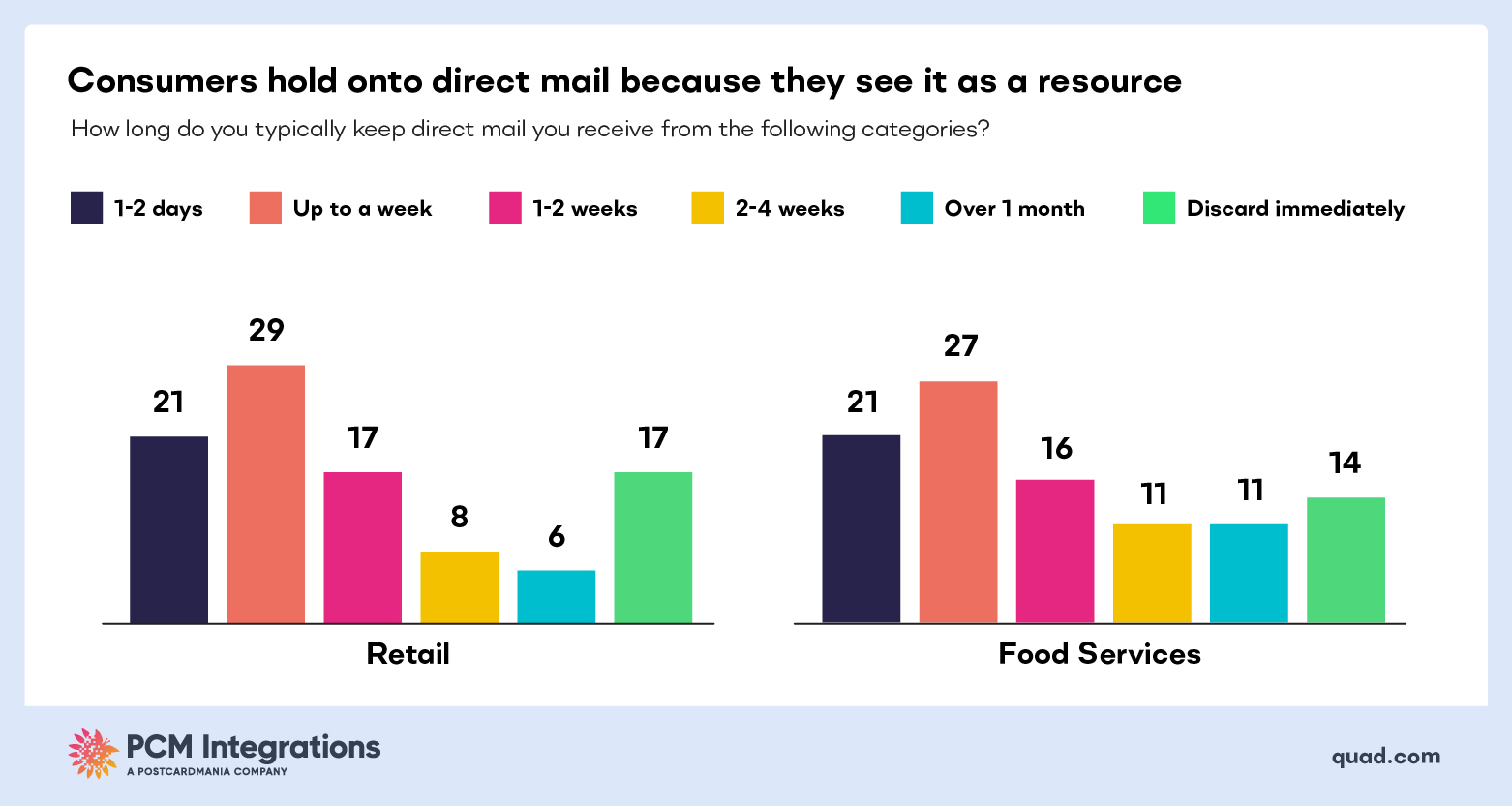
- 84% of consumers said that direct mail they receive from a company they purchase from regularly is useful — specifically “extremely useful” (24%), “very useful” (26%), or “somewhat useful” (34%). The Direct Marketing Revolution Report (2023)
- 69% of consumers engage with mail each week. Nearly 1/3 of consumers engage with direct mail daily. Direct Mail Industry Report 2023 (2023)
- 54% of consumers keep an interesting piece of mail and refer back to it later. Direct Mail Industry Report 2023 (2023)
- 45% of consumers state that direct mail feels less intrusive than other types of advertising. Direct Mail Industry Report 2023 (2023)
- 40% of consumers enjoy learning about new brands/products/ services through the mail. Direct Mail Industry Report 2023 (2023)
- Over 1/3 of consumers (38%) believed direct mail to be the most influential ad type. Paid online search or banner ads lagged behind at 22%, sponsored influencer content at 15%, and text message ads ranked the least influential at 14%. Direct Mail Industry Report 2023 (2023)
- More than 50% of consumers agree that low-quality paper/packaging and frequent mailings are most likely to give your mail piece a negative impression. Direct Mail Industry Report 2023 (2023)
- Compared to brand email messages, consumers believe direct mail to be 11% more personal, 17% more likely to catch their attention, and 17% more trustworthy. RRD (2023)
- Consumers consider these the top 4 benefits of receiving physical mail: 1) having a physical copy of information; 2) I can save a hard copy and refer back to it; 3) I don’t have to be on my phone or computer to read it; and 4) It’s easier to remember than email. RRD (2023)
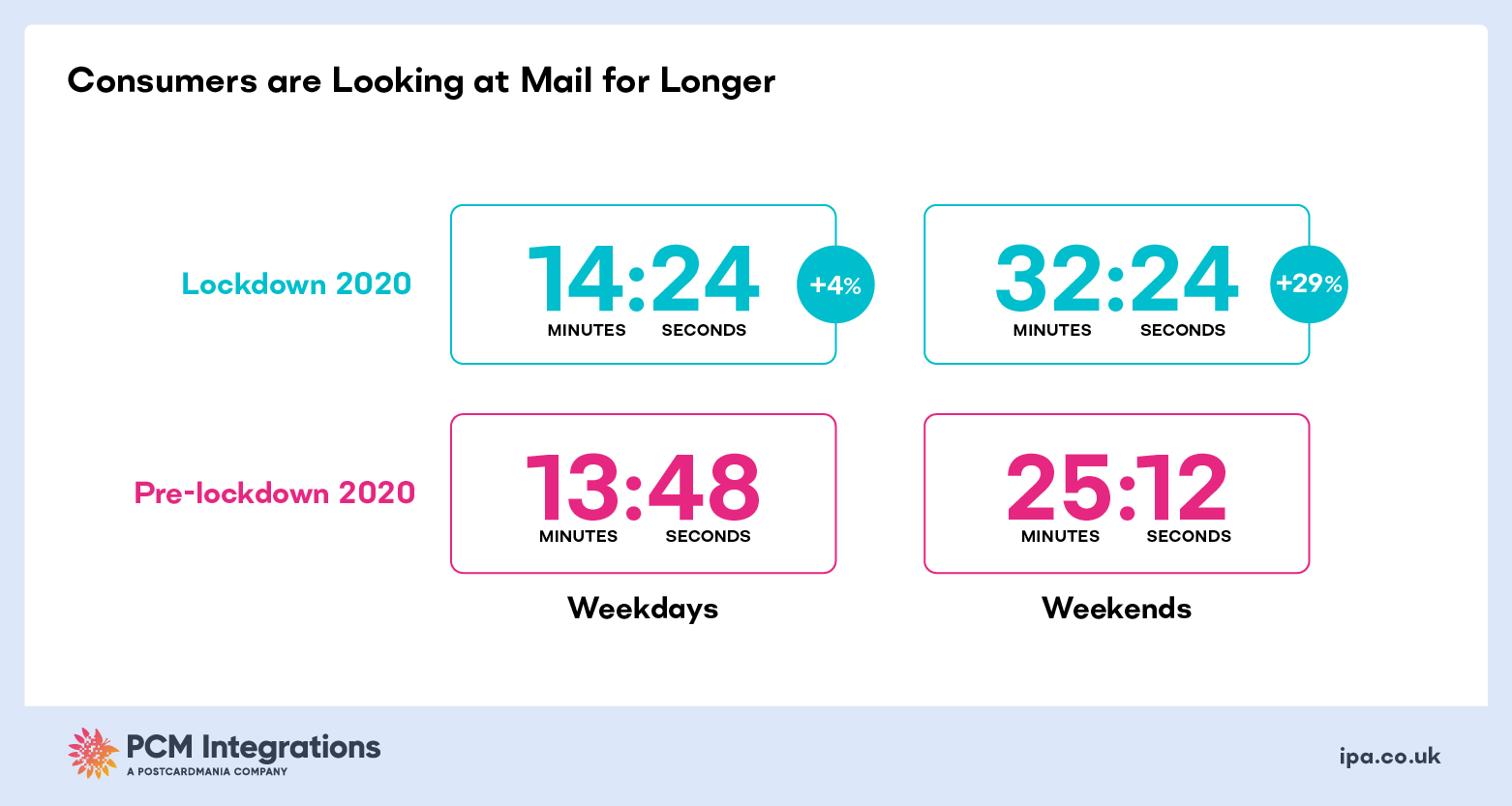
- Consumers are looking at mail longer. Pre-lockdown times were at 13 minutes and 48 seconds during the weekday, and 25 minutes and 12 seconds on the weekend; post-lockdown times were at 14 minutes and 24 seconds during the week and 32 minutes and 24 seconds during the weekend. MarketReach (2021)
- 87% of people consider mail to be believable compared to 48% for email. MarketReach (2020)
- 70% of people said mail, rather than email, gave them a better impression of the company that sent it. MarketReach (2020)
- 70% of consumers say mail makes them feel valued as a customer. MarketReach (2020)
- 70% of consumers prefer traditional mail for cold, unsolicited offers. The Data & Marketing Association (2018)
- 54% of consumers surveyed said they want to receive mail from brands they’re interested in. Marketing Sherpa (2017)
- A study called “The Private Life of Mail” revealed that 60% of people reported that direct mail had a more lasting mental impression on them. MarketReach (2015)
- In the same study, 57% also said that postcard marketing makes them feel more valued and creates a more authentic relationship. MarketReach (2015)
- 60% of consumers said direct mail makes more of an impression than any screen-based advertisement. MarketReach (2015)
- 4 out of every 10 Americans look forward to checking their mail every day. Gallup (2015)
- Direct mail can generate positive emotional responses from recipients. 66% of audiences reported it was the right way of informing, and 48% understood what was relevant to them and what was not. MarketReach (2015)
- 73% of American consumers say they prefer being contacted by brands via direct mail because they can read it whenever they want. Epsilon Channel Preference Study (2012)
Marketing campaigns are more effective when digital and print advertisements are combined.
How do direct mail and digital ads influence one another? The data shows that when the two are used together, they significantly boost response rates and deliver an even stronger return on investment.
- 60% of consumers say they are extremely/very likely to respond to an advertising promotion when they see it across multiple channels. The Direct Marketing Revolution Report (2023)
- On average, direct mail campaigns that included digital links yielded a response rate increase of nearly 9% in relation to static campaigns. Notably, larger firms reported slightly higher average response rates. Keypoint Intelligence (2023) (See the graphic below.)
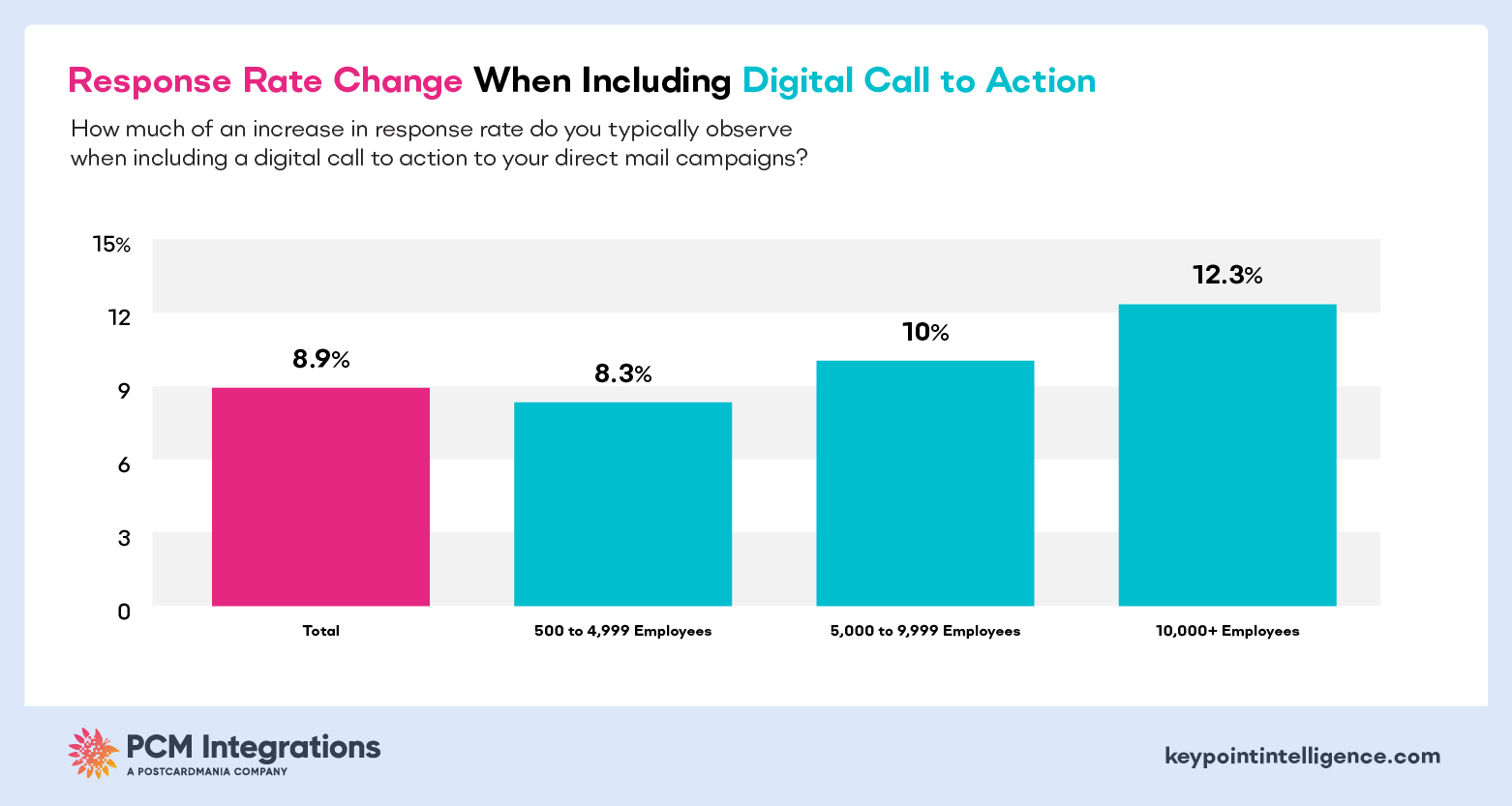
- The vast majority of businesses (97%) are incorporating digital links in their printed direct mail at least occasionally. Keypoint Intelligence (2023)
- 76% of B2B marketers say that their buyers are less likely to engage with digital marketing touchpoints than only a year ago. Direct Mail for the Digital Age (2023)
- 60% of consumers say they are extremely/very likely to respond to an advertising promotion when they see it across multiple channels. The Direct Marketing Revolution Report (2023)
- 39% of consumers said they are extremely or very likely to respond to an advertising promotion when they see it across multiple channels; the tally rises to 78% across the extremely/very/somewhat likely responses. The Direct Marketing Revolution Report (2023)
- 44% of consumers said they are extremely or very likely to open a direct mail offer when it is coordinated with a personalized email and social media ad; this rises to 78% when “somewhat likely” responses are added. The Direct Marketing Revolution Report (2023)
- 91% of marketers believe integrating direct mail and digital channels has a positive impact on campaign performance. Direct Mail Industry Report 2023 (2023)
- In 2022, only 24% of SMBs relied on a single marketing channel, underscoring the ongoing shift towards multichannel marketing tactics among these businesses. Over 75% used at least 2 marketing channels. 2023 Small Business Marketing Survey Report (2023)
- 59% of marketers are taking steps to better integrate their use of direct mail with other channels. Winterberry Group (2023)
- The most popular types of digital links included on direct mail pieces include personalized QR codes and personalized URLs (pURLs). Keypoint Intelligence (2023)
- Technological advances enhance direct mail’s effectiveness because they have bridged the gap between the print and digital worlds, offering personalized URLs, QR codes, and AR voice activation techniques to encourage users to interact with the brand. MarketReach (2021)
- When primed by mail, people spent 30% longer looking at ads on social media. JICMAIL (2020)
- Integrated direct mail and digital campaigns elicit 39% more attention than single-media digital campaigns. Canada Post (2016)
- Brand recall peaks when direct mail follows email, outperforming the average for the other single and integrated media campaigns by 40%. Canada Post (2016)
- Marketing campaigns that used direct mail and 1 or more digital media experienced a 118% lift in response rate compared to using direct mail only. Merkle (2015)
Personalized and automated direct mail generates an even greater response.
Modern direct mail delivers something traditional mail never could — a highly responsive, fully personalized experience tailored to each individual. The result? More leads, higher conversion rates, and stronger revenue. Postcards or letters can be automatically mailed at any point in your funnel based on unique triggers: abandoned shopping carts, interested visitors who left your website, or warm prospects who suddenly go silent. With the right data and simple automation, your mailers can fire off automatically whenever a prospect takes — or doesn’t take — a specific action. Check out the stats below that demonstrate just how powerful direct mail automation can be…
- The vast majority of respondents (98%) reported that personalized campaigns delivered significantly or moderately higher response rates. Keypoint Intelligence (2023)
- 87% of automation software users agree that direct mail provides the best ROI of any channel compared to 79% of non-users. CompereMedia (2024)
- 84% of consumers say they are more likely to open a personalized piece of direct mail. IWCO (2024)
- 75% of automation software users are able to measure the ROI of their direct mail efforts vs. 62% of non-users. CompereMedia (2024)
- Among the 858 respondents who used direct mail to reach their customers, a strong majority (86%) were personalizing or customizing it for more targeted messaging. Some examples of customization include changing images or modifying text for different groups of recipients. Keypoint Intelligence (2024)
- 56% of respondents are using a direct mail automation software/technology platform to execute direct mail campaigns. This is an increase from 40% in 2023. CompereMedia (2024)
- On average, marketers who were creating more targeted direct mail estimated that about 60% of their total direct mail campaigns included personalization or customization. Keypoint Intelligence (2023)
- Among marketers who move to a more programmatic approach for their direct mail pieces, they see engagement numbers increase by as much as 45% after making the shift. SG360 (2023)
- 65% of direct mailers employ direct mail retargeting. SG360 (2023)
- Direct mail automation is used by 84% of responding marketers. Direct Mail Industry Report 2023 (2023)
- When asked about new ideas and strategies for future campaigns, marketers indicated direct mail automation is the most likely to be tested this year (84%), just edging past creative and digital integration strategies (83% each). Direct Mail Industry Report 2023 (2023)
- Nine out of ten marketers are focused on mail automation optimization and scale. Direct Mail Industry Report 2023 (2023)
- 45% of automated mail campaigns are produced by in-house teams. Direct Mail Industry Report 2023 (2023)
- 53% of marketers are shifting to more personalized content over the next year, a goal often met by the personalization offered by automation. Winterberry Group (2023)
- When asked about the level of impact they expect AI will have on direct marketing activities over the next two years, 76% agreed that it will be significant or transformative. Keypoint Intelligence (2023)
- 50% of marketers who automate direct mail feel like their company can determine ROI. The State of Direct Mail (2023)
- 40% of marketers use a technology platform to execute direct mail campaigns. The State of Direct Mail (2023)
- 76% of B2B marketers rate the ability to automate mail creation and delivery tied to buyer purchase signals and behavior as valuable, with 32% rating it as highly valuable. Forrester Opportunity Snapshot (2022)
- 84% of marketers report that direct mail improves multichannel campaign performance. Demand Metric (2020)
- Marketers who use 4-6 channels in their multichannel campaigns report the best response rates. Demand Metric (2020)
- Only 40% of marketers use a technology platform to execute direct-mail campaigns. Comperemedia (2023)
- The use of direct mail automation is highest when a company’s email/digital team is in charge of executing direct mail campaigns. If a dedicated marketing manager or team executes direct mail campaigns, the use of automation declines to 31%. Comperemedia (2023)
- 64% of affluent customers say a coupon or discount speeds up their decision to purchase. Vericast Consumer Intel Report (2021)
- 79% of affluent customers say it’s exciting to discover a coupon or discount on a product they were already thinking about buying. Vericast Consumer Intel Report (2021)
- 84% of people in a study said they were more likely to open/pay attention to a direct mail piece if it was personalized. InfoTrends (2015)
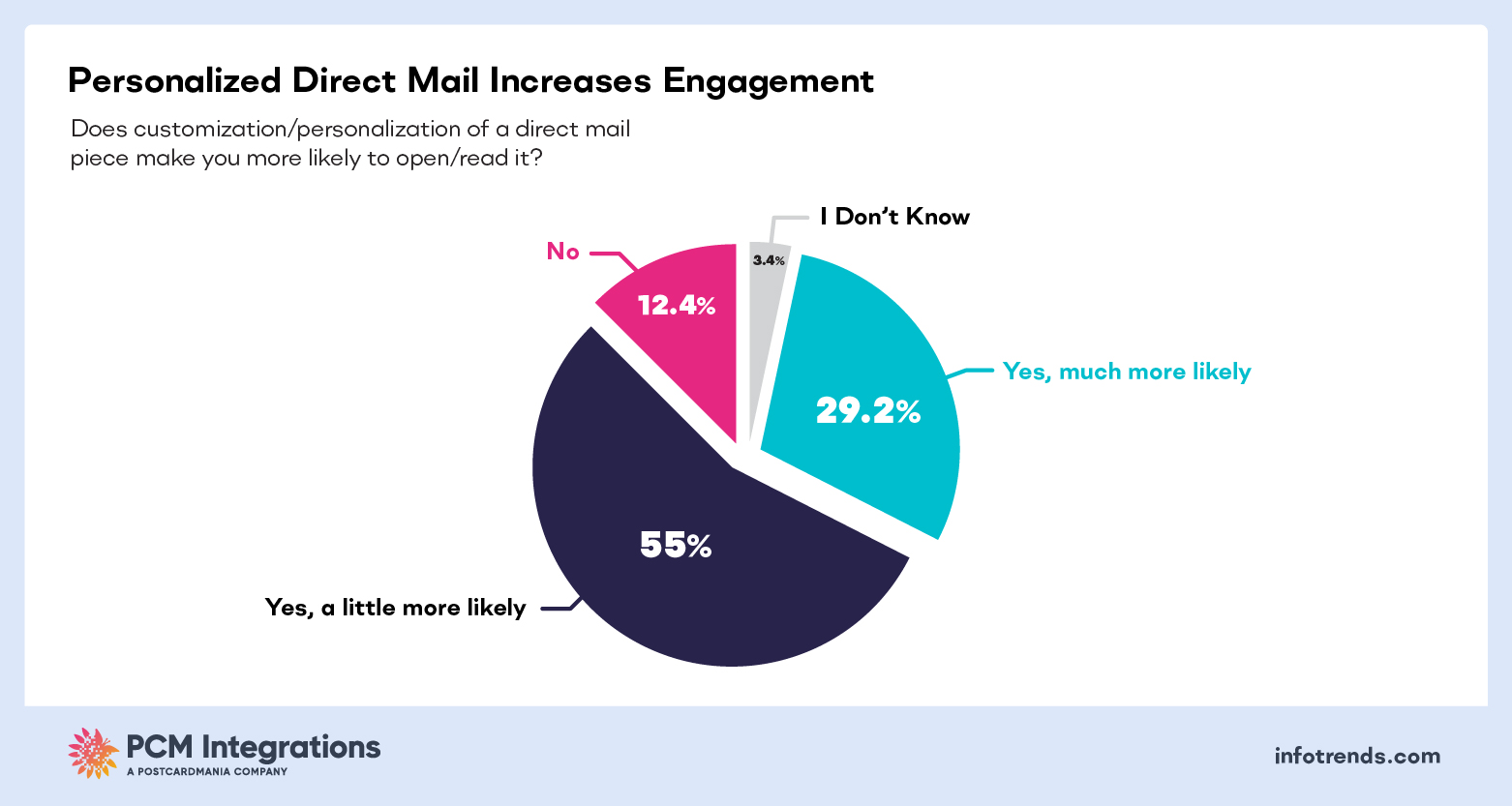
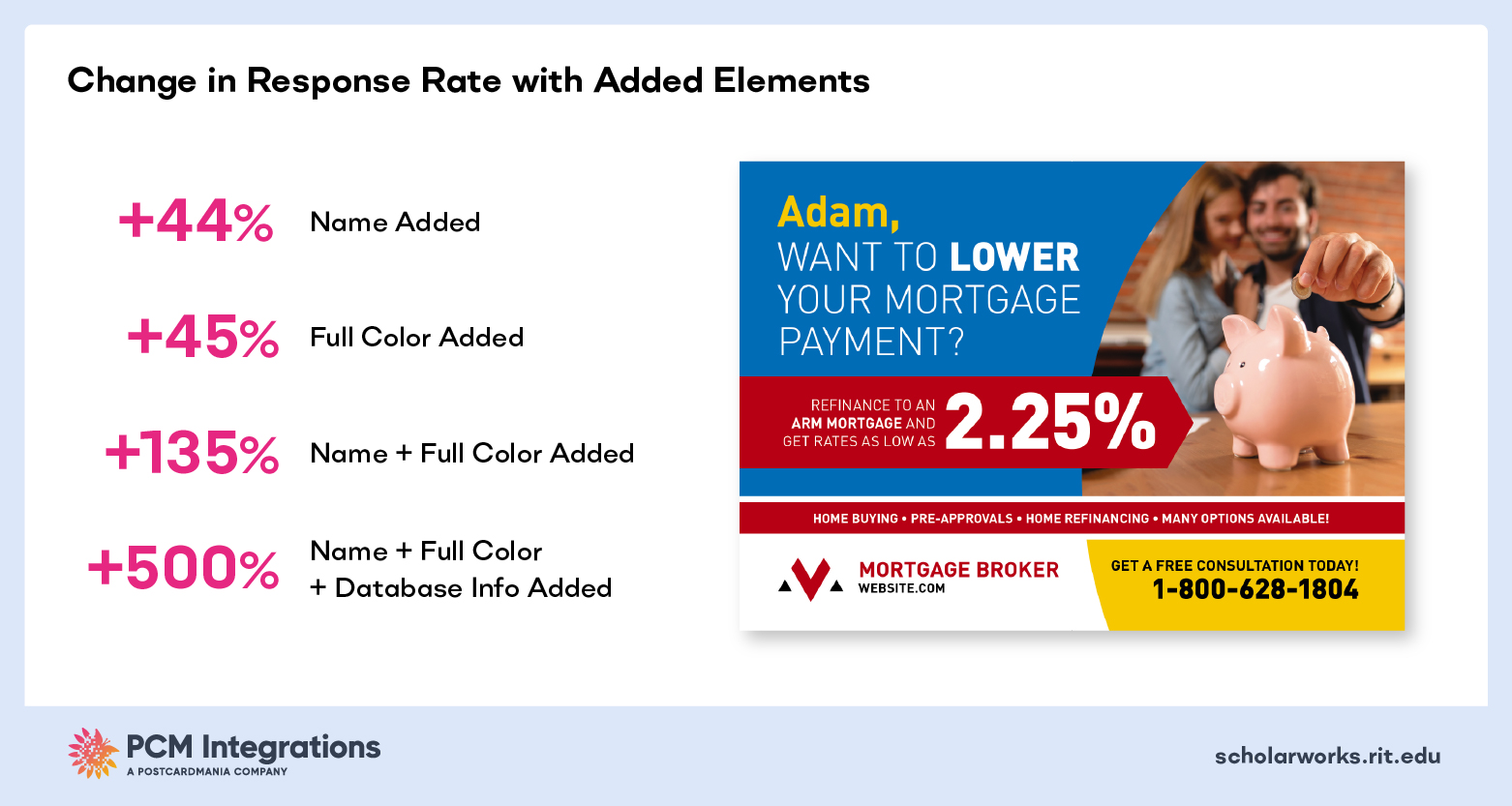
- A study by Frank Romano and David Broudy revealed that the response rate to direct mail increased by 135% when it was personalized by the recipient’s name and was in full color. When all factors were combined—name, color, and database information—the response rate went up even higher to 500%. “An Investigation into Printing Industry Demographics.” By Frank Romano and David Broudy, Rochester Institute of Technology (2010)
How can I get started with direct mail automation?
If you want to latest direct mail marketing technology and expertise, work with a professional like us. We have more than 27 years of experience and mail out of a state-of-the-art facility in Clearwater, Florida, that reliably delivers mail lightning fast—in as little as 24 hours!
To get started, check out our automated mail systems that include:
- Direct mail integrated with a Contact Relationship Management (CRM) system
- Unique triggers that allow you to “set and forget” your marketing plan
- There are no monthly fees or subscriptions with our automated direct mail plans
- Only pay for what you mail
- Easy and fast setup
We can set up a demo for you today. Contact us to schedule a quick call with PCM Integrations and get started!